ESD Safety Monitoring System for Automotive Paint Booth

Automotive paint booths operate in environments containing highly flammable paint particles, solvents, and volatile organic compounds (VOCs). Electrostatic discharge (ESD) generated by personnel, equipment, vehicle bodies, or paint application systems can create sparks capable of igniting combustible atmospheres, resulting in fire hazards, explosions, production losses, and safety incidents.

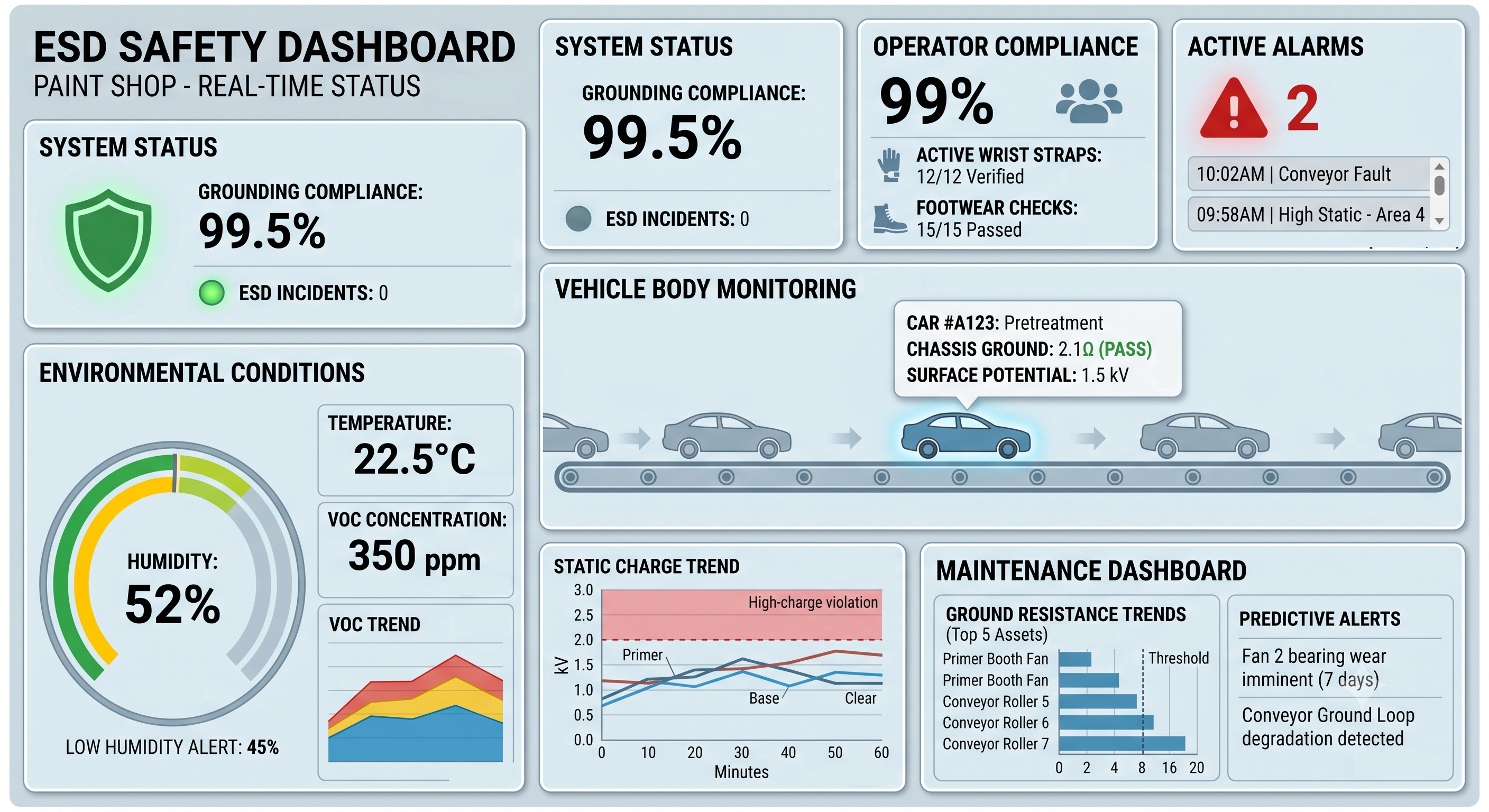
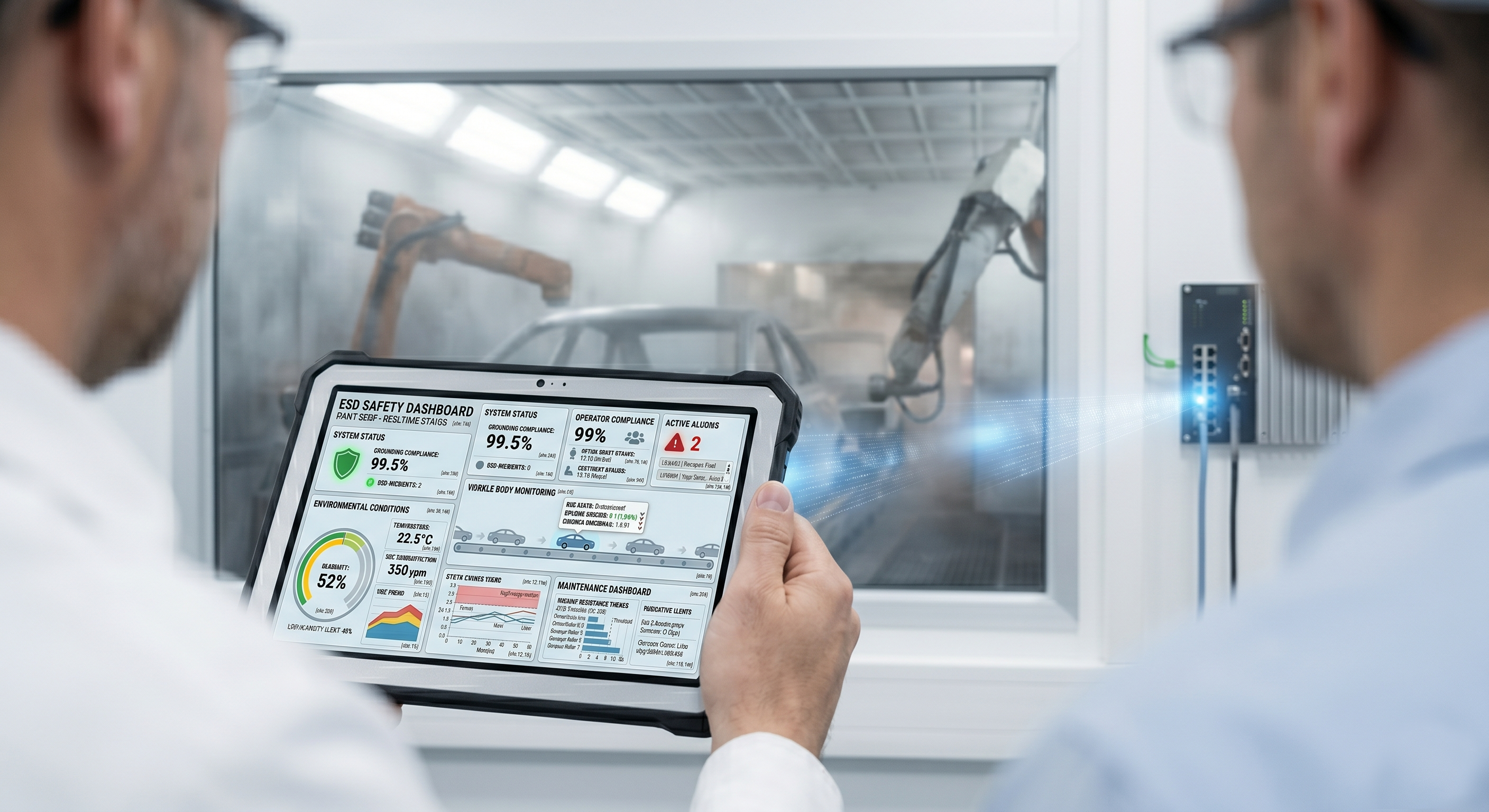
To mitigate these risks, an Industrial IoT-based ESD Safety Monitoring System was implemented to continuously monitor grounding integrity, electrostatic charge levels, personnel compliance, and environmental conditions in real time. The system provides predictive alerts, compliance reporting, and centralized monitoring to ensure a safe painting environment.

Start with One Machine Request a Demo

Application Area

Automotive Paint Shop

Pretreatment Area
Primer Booth
Base Coat Booth
Clear Coat Booth
Paint Mixing Room
Flash-Off Zone
Oven Entry Area


Business Challenge

The automotive manufacturer experienced several operational risks associated with electrostatic charge accumulation.

Key Challenges

Lack of real-time ESD monitoring.
Manual verification of grounding systems.
Static charge accumulation on vehicle bodies.
Inconsistent operator grounding compliance.
Risk of spark generation in solvent-rich environments.
Limited visibility of paint booth safety conditions.
Difficulty maintaining safety audit records.
High dependence on manual inspections.


Project Objectives
The Project Aimed to

Prevent electrostatic discharge incidents.
Ensure continuous grounding compliance.
Monitor static charge accumulation in real time.
Improve personnel safety.
Reduce fire and explosion risks.
Enable predictive maintenance of grounding systems.
Automate ESD compliance reporting.
Integrate safety monitoring with plant SCADA systems.


Solution Overview

From the Floor to Insight

automative paint both

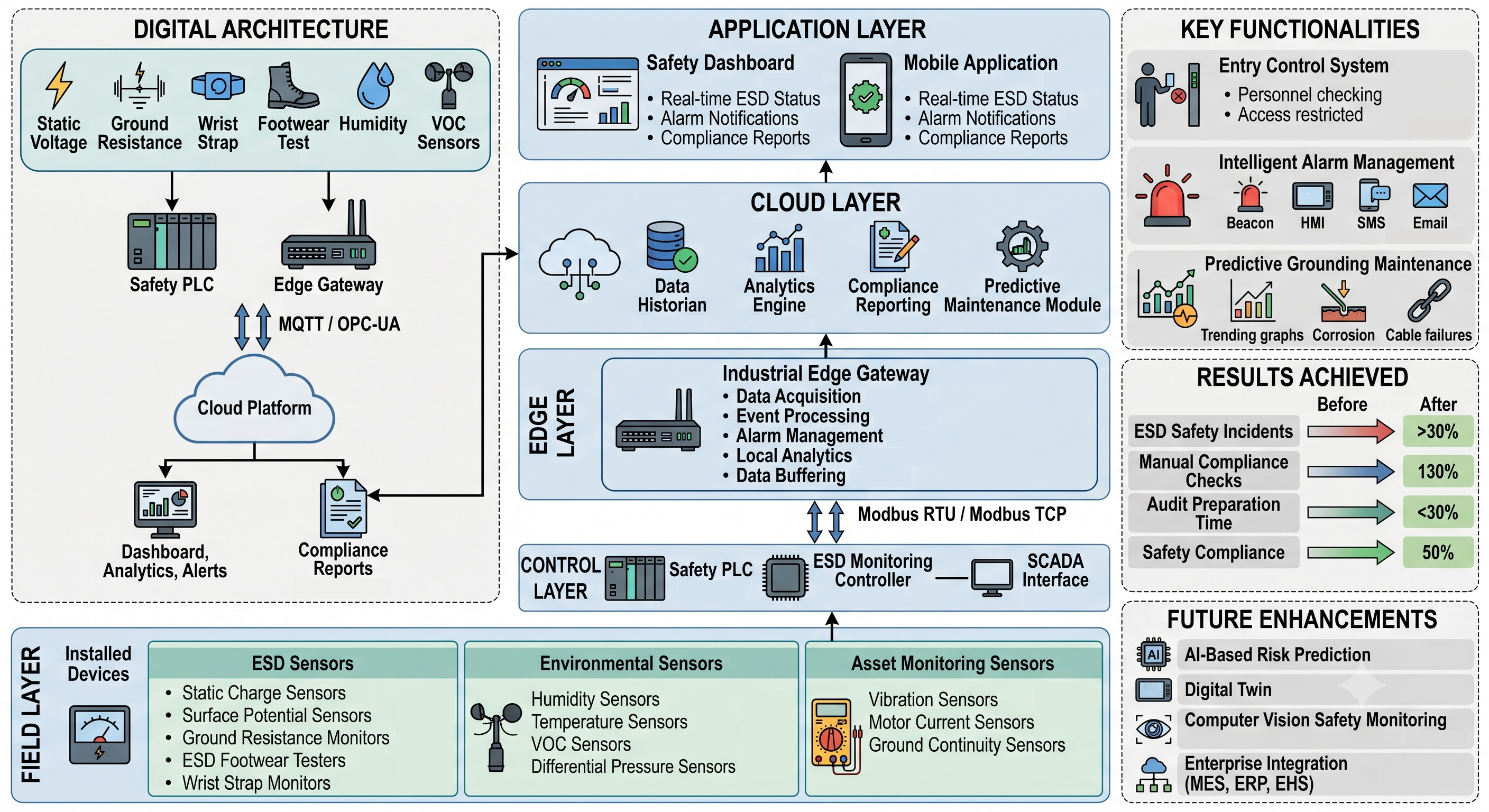
The solution combines ESD monitoring hardware, Industrial IoT gateways, cloud analytics, and safety dashboards.

The system continuously measures

Ground resistance
Static voltage
Personnel grounding status
Vehicle body grounding condition
Booth environmental conditions
Equipment grounding health


Critical Parameters Monitored
Personnel Safety Monitoring

Wrist Strap Monitoring
Ground continuity.
Resistance verification.
Compliance status.
ESD Footwear Monitoring
Footwear resistance.
Ground path verification.
Entry authorization.
Operator Identification
RFID-based personnel tracking.
Compliance logging.


Vehicle Body Monitoring

Vehicle Ground Integrity
Chassis grounding resistance.
Paint conveyor grounding status.
Static Charge Measurement
Surface electrostatic voltage.
Charge accumulation trend.


Paint Booth Monitoring

Environmental Parameters
Temperature
Humidity.
Airflow.
Differential Pressure.
VOC Concentration.
TemperatureLow humidity conditions are known to increase static charge generation and require continuous monitoring.


Equipment Monitoring

Electrostatic Paint Applicator
Gun grounding resistance.
Voltage monitoring.
High-voltage supply health.
Conveyor System
Ground continuity.
Roller grounding.
Bearing insulation issues.

System Architecture

Key Functionalities

Real-Time ESD Monitoring
Continuous monitoring of: Static voltage.
Ground resistance.
Personnel grounding.
Equipment grounding.
Entry Control System
Personnel entry into paint booth areas is permitted only when: ESD footwear passes compliance check.
Wrist strap grounding is verified.
Employee authorization is confirmed.


Intelligent Alarm Management

Alerts generated for
Grounding failure.
Static charge threshold exceeded.
Wrist strap disconnection.
Conveyor grounding fault.
Low humidity condition.
Excess VOC concentration.
Alert Modes
Beacon Lights.
HMI Alerts.
SMS Notifications.
Email Notifications.


Predictive Grounding Maintenance

The system continuously trends:
Ground resistance degradation.
Corrosion effects.
Cable failures.
Ground loop integrity.
Potential failures are predicted before safety incidents occur.

Compliance Reporting

Automatic generation of:
Daily ESD Compliance Reports.
Shift-wise Operator Compliance Reports.
Grounding Verification Logs.
Audit Trail Reports.
Safety Incident Reports.


Results Achieved


KPI Before After
ESD Safety Incidents 8/year 0/year
Manual Compliance Checks 100% 10%
Grounding Fault Detection Time 6 hrs Real Time
Audit Preparation Time 3 Days 30 Minutes
Safety Compliance High Near Zero


Business Benefits

Safety Benefits
● Reduced fire risk
● Reduced explosion risk
● Improved worker safety
● Enhanced ESD compliance
Operational Benefits
● Automated monitoring
● Faster incident response
● Improved traceability
● Centralized visibility
Maintenance Benefits
● Predictive maintenance
● Reduced equipment failures
● Improved grounding reliability
Financial Benefits
● Reduced downtime
● Reduced insurance risk
● Lower compliance costs
● Improved production continuity


Conclusion

The ESD Safety Monitoring System transformed the automotive paint booth into a safer and more intelligent manufacturing environment. Through continuous monitoring of static charge levels, grounding integrity, environmental conditions, and personnel compliance, the organization significantly reduced safety risks while improving operational efficiency and regulatory compliance. The solution serves as a scalable Industry 4.0 safety framework for modern automotive paint shop operations.